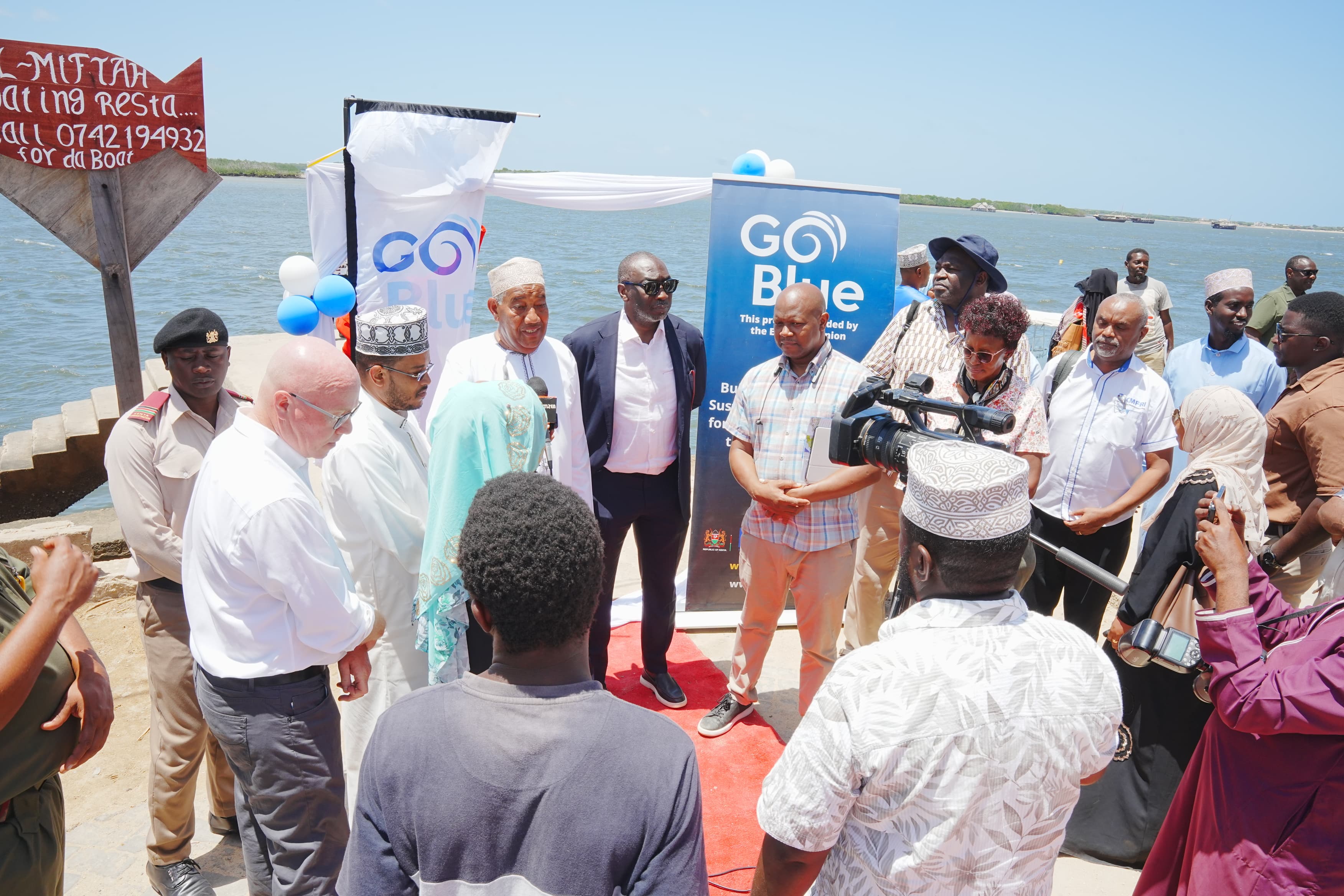
Lamu County has taken a pioneering step in sustainable development by preparing Kenya’s first County Spatial Plan to integrate both land and sea. The revised draft plan (2026–2036), supported under the European Union–funded Go Blue Project, was formally handed over to county officials today. The County Government will now lead the statutory approval process toward formal adoption.
This milestone was marked alongside the opening of the upgraded King Fahd Park, a vibrant public space revitalized by UN-Habitat to enhance quality of life and catalyse inclusive urban growth, and the presentation of progress on the mangrove Blue Carbon programme, which has completed a Project Idea Note (PIN) currently awaiting validation by Plan Vivo. The next step will be the development of a Project Design Document (PDD), moving Lamu closer to accessing climate finance through carbon markets.
Go Blue, funded by the European Union and jointly implemented by UNEP and UN-Habitat, seeks to build a sustainable blue economy across Kenya’s six coastal counties by addressing the triple planetary crisis of climate change, nature loss, and pollution, while generating social and economic benefits for communities.
“The Go Blue programme has truly been a flagship initiative to raise awareness about the sustainable blue economy in Kenya. We combined land and sea projects because there is no green without blue, and no blue without green. By linking policy with practical implementation and drawing on the unique expertise of UN-Habitat and UNEP, Kenya has provided the perfect enabling environment to showcase what can be achieved,” said the EU Ambassador to Kenya.
“The launch in Lamu demonstrates how urban planning, public spaces, and marine conservation can work together to drive sustainable growth. Public spaces like the King Fahd Park are vital entry points for inclusive transformation, and by linking land and sea planning, Lamu is setting a new benchmark for resilience across coastal Africa,” said Ishaku Maitumbi, Head of Eastern and Horn sub region, Regional Office for Africa, UN-Habitat.
“Lamu is leading the way by embedding marine elements into its County Spatial Plan, creating a blueprint for others to follow. From mangrove restoration to blue carbon readiness, this approach reflects UNEP’s commitment to tackling climate change, biodiversity loss, and pollution while supporting communities to thrive with healthy ecosystems,” said Sinikinesh Beyenne Jimma, Chief of the Marine & Coastal Unit, UNEP.
The initiatives in Lamu contribute directly to the achievement of several Sustainable Development Goals (SDGs), including:
- SDG 11 (Sustainable Cities and Communities): through the revitalization of King Fahd Park.
- SDG 13 (Climate Action): through blue carbon readiness and integrated planning.
- SDG 14 (Life Below Water): by embedding marine ecosystems in development planning.
By linking ecosystems, urban spaces, and community well-being, Lamu is positioning itself as a model of resilience and sustainability along Kenya’s coastline — and a demonstration of how international partnerships can deliver impact at the local level.